
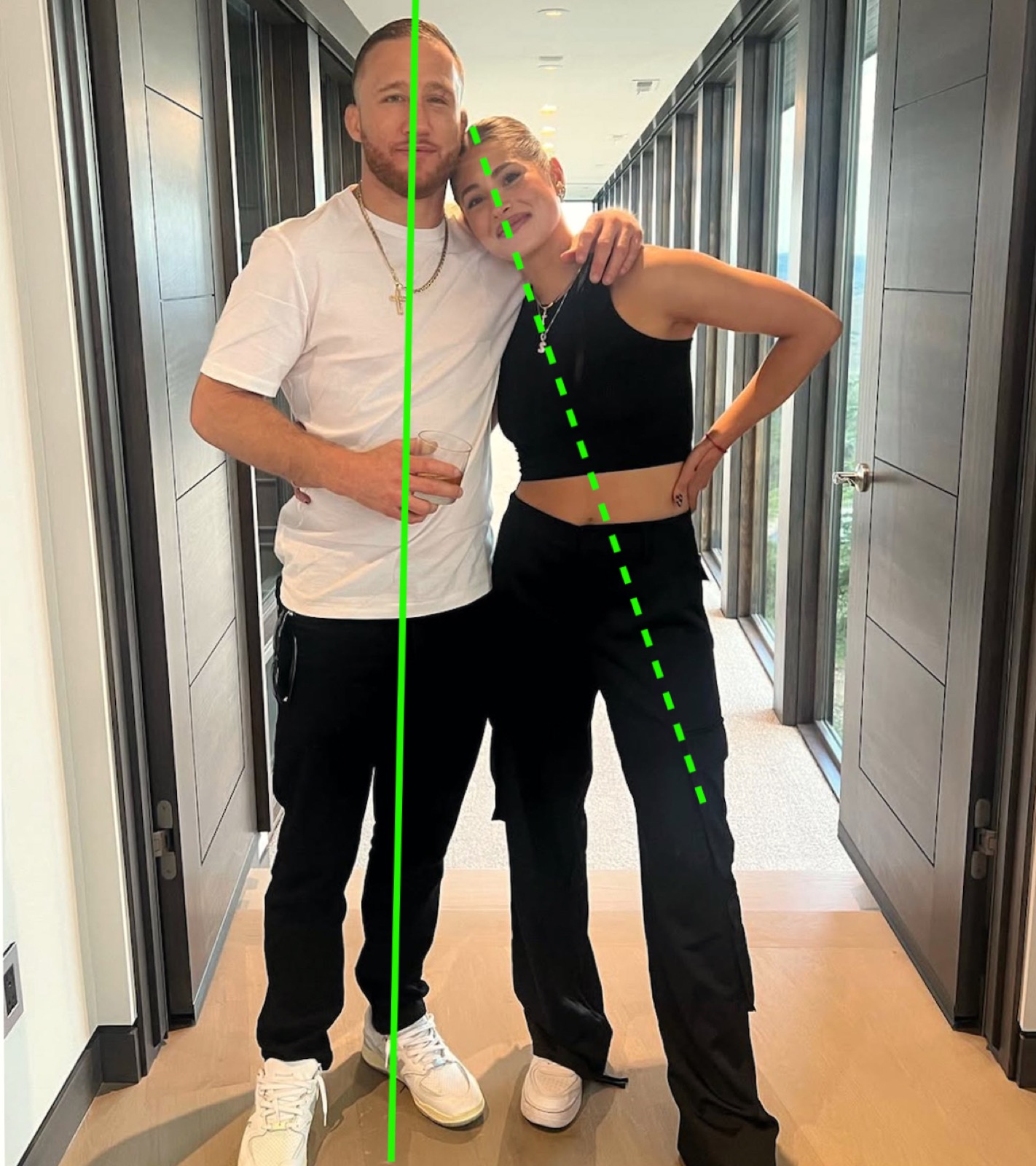
What is the Green Line Test?
Draw a straight line through each person's visible head and torso, then compare those lines with vertical. The result makes a small difference in posture easy to see. People use the overlay as a joke, a photo-editing challenge, or a way to recreate a viral image.
The word theory in Green Line Theory names an internet idea. It does not turn the drawing into a scientific relationship test. A photograph shows a pose in one moment; it does not supply a score for love, confidence, or compatibility.
Where did Green Line Theory come from?
Know Your Meme's archive traces early posts to Rivelino on Twitter in May 2020 and documents the trend's later spread. The original framing linked leaning to relationship power. That history explains the meme; it is not evidence that the claim is correct.
Different creators draw and label their images differently. Our app uses solid lines for upright poses and dashed lines for leaning poses, with STRONG and WEAK labels. Those are our entertainment labels, not personality classifications.
How do you read the lines?
| Visible pose | What the overlay shows | What it does not establish |
|---|---|---|
| One person upright, one leaning inward | Different torso directions in this frame | Who cares more |
| Both upright | Two roughly vertical axes | Equal power or emotional distance |
| Both leaning inward | Two axes pointing toward the center | Compatibility or dependency |
| Leaning outward | An outward pose that needs context | Conflict or a future breakup |
The illustrations on this page keep the same two figures and change only their poses. The apparent result changes immediately. For a fuller walkthrough, read what Green Line Test results mean.
Is the Green Line Test real?
It is a real photo trend and a real editing effect. Our product does not claim that its labels measure relationship quality. Height differences, a tilted camera, a chair, or directions from a photographer can change how an axis looks.
An AI-generated overlay also involves estimation. A line can be misplaced, especially when the body is cropped or obscured. A polished image should not be mistaken for a calibrated measurement. See does the Green Line Test actually work? for practical limitations.
How can you try it?
You can draw lines manually in a photo editor or use our online Green Line Test. Our AI tool requires a Google account and purchased credits: the Starter pack includes 3 analyses for $4.99. Review current packs before uploading.
Choose a photo you have permission to use, with two clearly visible people and a reasonably level camera. Follow the step-by-step guide, then compare the overlay with the original. Keep the result as a playful edit, not evidence about someone else's private life.