
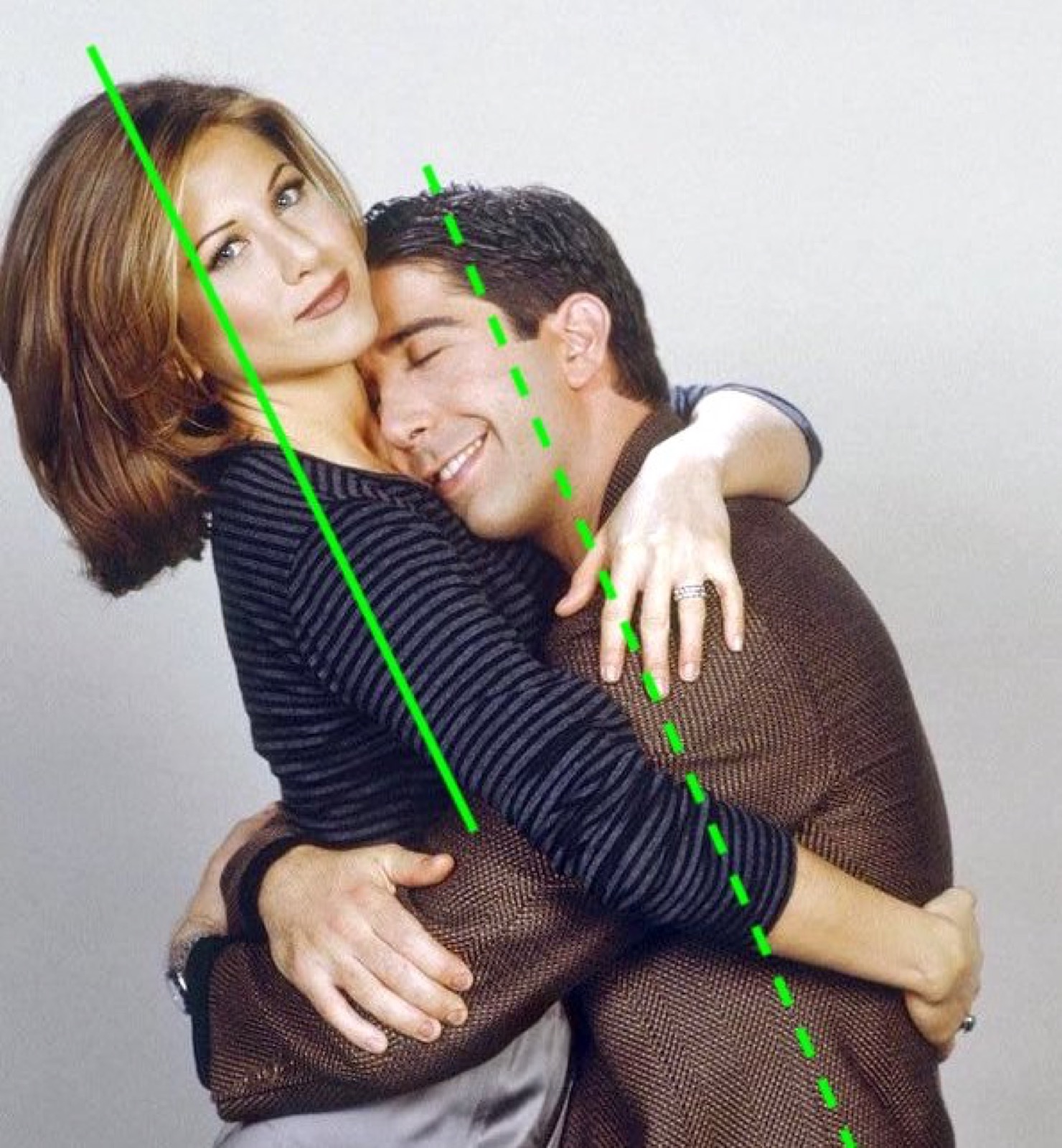
What counts as working?
There are two separate questions. Can an editor draw lines that roughly follow the people in an image? And do those lines reveal something reliable about their relationship? A convincing answer to the first question does not answer the second.
Our app is built for the first task: generate a green-line overlay and entertainment labels. It is not a relationship assessment. We do not publish a relationship-prediction accuracy percentage because we do not have a validation study that would support one.
Why can the same couple get different results?
A camera records one frame. The next photo may show a different step, pose, head position, or camera angle. A person who leans toward the center for a selfie might stand upright in a formal portrait.
You can demonstrate this visually using the four pose illustrations on this page. They deliberately keep the figures the same and change the pose. This is an illustration of the rule, not an experiment on real relationships.
If you compare your own photos, include ordinary and unflattering frames instead of selecting only the ones that support a story. Do not assign a relationship score to either set.
What does the research say?
Research on nonverbal behavior examines more than a green line. A 2021 editorial by Patterson and colleagues discusses the complexity of studying nonverbal communication. It is not a validation of this meme.
The separate 2019 review by Barrett and colleagues describes limits on inferring emotion from facial movements. That finding concerns faces and context; it is not a direct test of torso lean. We link these sources to clarify the boundary, not to claim scientific endorsement.
For a more detailed explanation of evidence, measurement, and validation, read Green Line Test psychology and science.
What can make the overlay itself wrong?
- Cropping: a visible face alone is not enough to establish a torso axis.
- Occlusion: arms, clothing, or another person can hide the body.
- Camera rotation: a sloping image makes upright people appear tilted.
- Seating and movement: bending or walking does not fit a simple standing comparison.
- Generative editing: the model can misplace a line or change parts of the original photo.
These are reasons to compare the result with the source image. They are not signs that the model has discovered something invisible to you.
Is it still useful for anything?
It can be a playful visual edit, a way to recreate an internet meme, or an exercise in noticing how posing affects a photograph. Keep the use aligned with what the tool provides.
For an image you intend to share, check that both people are comfortable with the labels and that the edit preserves the picture well enough for your purpose. A paid generation does not make the interpretation more scientifically valid.
What should I do with my result?
Describe it literally: “this line leans inward” or “both lines look upright.” If you want to understand the labels, use the results guide. If you want to improve the drawing, use the photo instructions.
Questions about an actual relationship need information beyond a selected photograph. This tool cannot resolve them.