
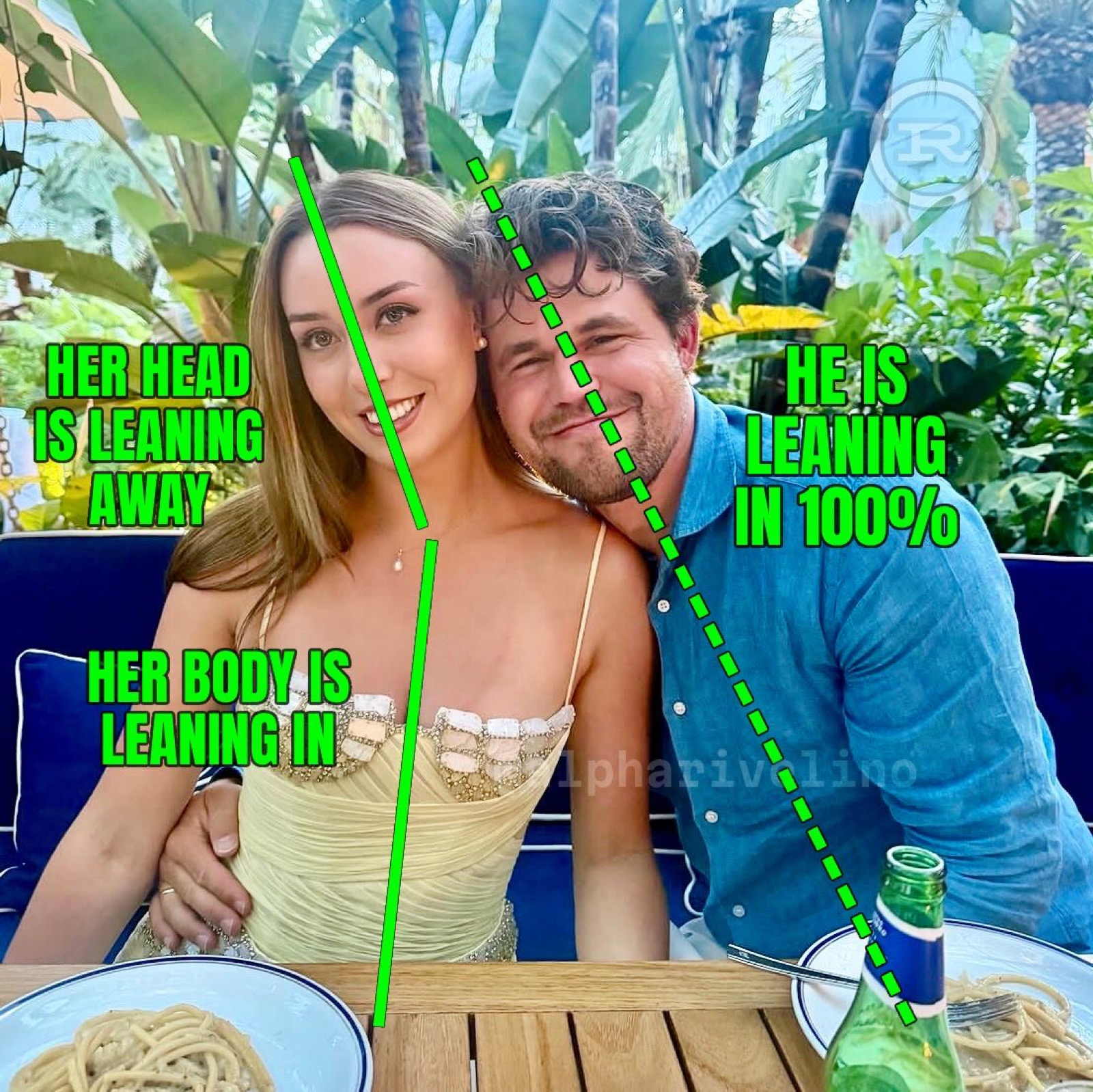
The Height Problem Nobody Talks About
There's a fundamental flaw in the Green Line Test that breaks the entire theory: height difference. If one partner is significantly taller than the other, the taller person will almost always appear to "lean in" — and the test will label them "WEAK."
This means millions of tall people are being labeled as the submissive partner in their relationships based purely on physics, not body language.
The Physics of Standing Next to a Shorter Partner
When a 6'2" man stands next to a 5'4" woman, basic human ergonomics create an automatic lean:
- Eye contact requires angling down — to look at a shorter partner, you naturally tilt your head and upper body
- Conversation proximity — to hear each other at comfortable volume, the taller person moves closer and leans
- Affection — putting an arm around a shorter person requires shoulder drop and lean
- Photo posing — photographers often ask couples to "get closer," which means the taller person bends
None of this has anything to do with emotional dependence, submission, or relationship power dynamics. It's simply what human bodies do when there's a height gap.
How Camera Angles Make It Worse
Photography amplifies the height-lean effect:
- Shooting from below (common for standing portraits) exaggerates the taller person's forward lean
- Wide-angle lenses (common on phone cameras) distort perspective, making closer objects appear larger and creating apparent lean
- The photographer's position often forces the couple to angle their bodies, creating asymmetric posture
- Group composition rules mean photographers position taller people slightly behind, which creates a lean toward the front
A professional photographer could make the same couple appear "STRONG" or "WEAK" simply by changing their shooting angle.
The Footwear Factor
This one gets overlooked: shoes dramatically change posture.
- High heels shift weight forward and create an upright, chest-out posture
- Platform shoes add height but also change natural stance
- Flat shoes vs. dress shoes create different baseline postures
- Barefoot vs. shod creates entirely different body alignment
A woman wearing 4-inch heels will appear significantly more "upright" than the same woman in sneakers. The Green Line Test doesn't account for this at all.
Celebrity Examples That Prove the Point
Tom Holland & Zendaya
Zendaya is slightly taller than Tom Holland, which creates fascinating Green Line Test results. In many photos, Tom appears to lean toward Zendaya — but when Zendaya wears heels, the dynamic visually flips. Same couple, same relationship, different "results" based on shoe choice.
Taylor Swift & Travis Kelce
Travis Kelce is 6'5" to Taylor's 5'11". Despite this being a relatively small gap for his height, Travis consistently shows a lean in photos. Green Line enthusiasts label him "WEAK" — but he's simply a very tall person standing next to a tall-but-shorter partner.
Nicole Kidman & Keith Urban
Nicole Kidman is 5'11" and often wears heels that make her taller than Keith Urban (5'10"). The Green Line Test results flip depending on footwear — proving the test measures shoes, not relationship dynamics.
Sophie Turner & Joe Jonas
At 5'9", Sophie Turner was notably taller than Joe Jonas (5'9" in shoes). Their Green Line Test results were all over the map because there was virtually no height difference, meaning any lean in either direction was meaningful noise.
What Body Language Experts Say About Height and Leaning
Patti Wood, a body language expert with over 25 years of experience, has specifically addressed the height-lean issue: leaning toward a shorter partner means "I care about you more than the cameras." It's an act of accommodation and affection, not weakness.
Dr. Rana Tayara, a therapist consulted by Glam magazine, pointed out that NASA uses a "lean test" for orthostatic intolerance — the medical version of a lean test has nothing to do with relationship dynamics. Physical factors (blood pressure, fatigue, balance) affect posture far more than emotional state.
Mike Carter, a body language expert, notes that "leaning is instinctive" when there's a height difference. Calling it weakness "misreads a basic human accommodation as a power dynamic."
How to Interpret Results With Height Difference
If there's a significant height gap in your couple photo, here's a more honest reading:
- Ignore the taller person's lean entirely — it's physics, not feelings
- Focus on other body language cues — are they touching? Making eye contact? Genuinely smiling? See our guide on what body language experts actually look for
- Try photos where both are seated — sitting eliminates the height variable
- Use multiple photos — follow our 5 tips for accurate results
- Remember it's entertainment — the Green Line Test is fun, not diagnostic
The Bottom Line
The Green Line Test was designed for couples of similar height standing side by side. The moment height difference enters the picture, the test breaks. A 6'5" man labeled "WEAK" for leaning toward his 5'2" partner isn't showing emotional dependence — he's just being a considerate human.
Try It Anyway
Height flaw and all, the Green Line Test is still entertaining. Upload your couple photo and see what the AI thinks: