
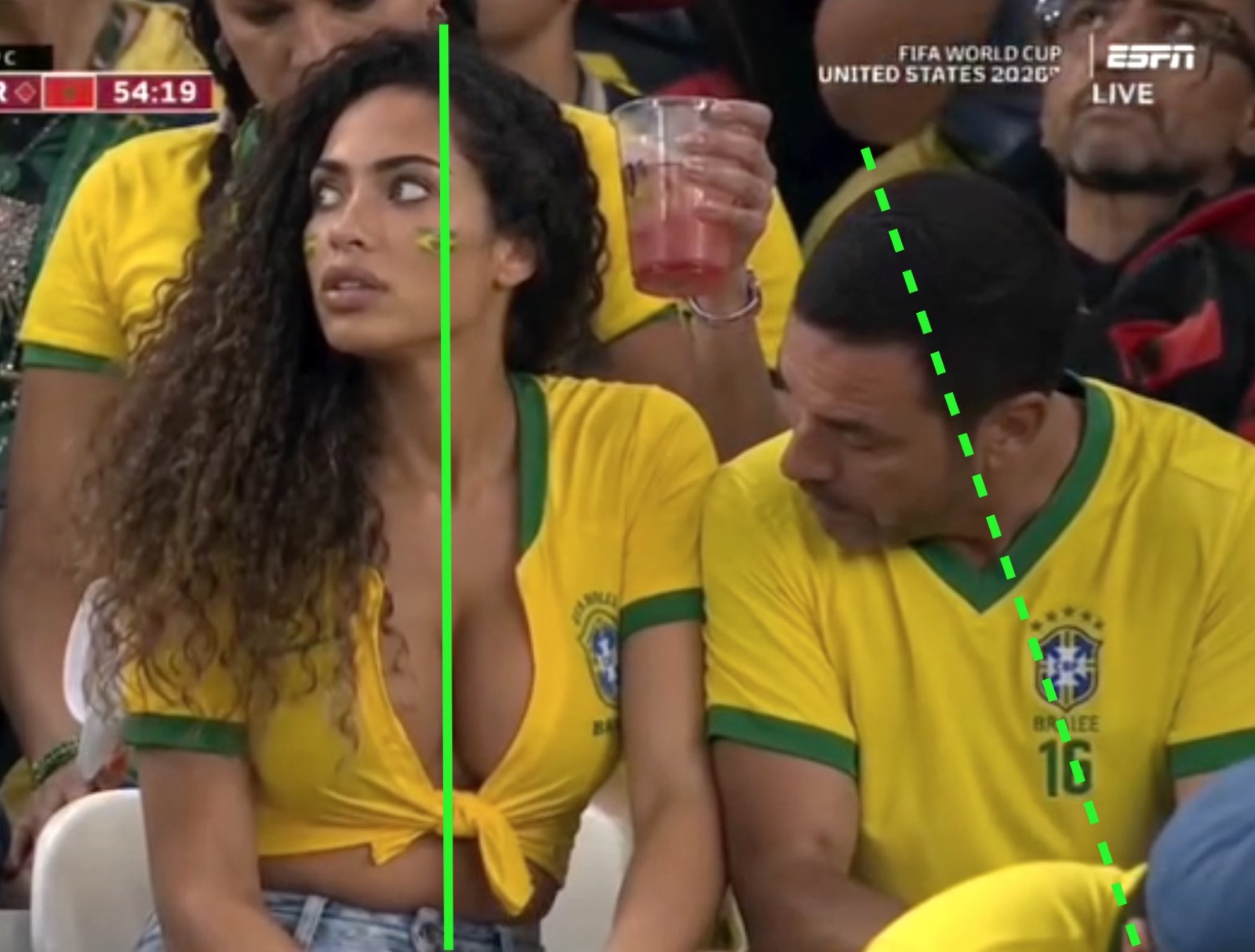
What do STRONG and WEAK mean here?
In our app, a solid vertical line is paired with STRONG and a dashed leaning line with WEAK. These labels are an entertainment convention. They should not be read as a description of either person's character or role in a relationship.
Read the image in two steps: first describe the visible direction of each torso, then check the context. If a line misses the torso, the output is an editing error. There is no need to invent a psychological explanation for it.
One upright person and one leaning inward
The drawing highlights a difference between two body axes. The lean could come from a pose, moving closer to fit into the photo, or accommodating a height difference. The still image does not tell you which explanation applies.
The meme often interprets the lean as greater emotional investment. Our tool does not measure that. Changing the pose can change the label without changing anything about the relationship.
Both people standing straight
Two vertical lines mean that both axes look upright in this frame. People sometimes call this a double-strong result. It does not establish equal power, a perfect match, or emotional distance.
Look at whether the photo was formally posed. An instruction such as “stand tall and face the camera” is enough to produce this pattern.
Both people leaning toward each other
Keep both tilted lines when that is what the photo shows. Both people might be squeezing into a selfie or following a photographer's direction. A symmetrical drawing is not a compatibility score.
The both-leaning guide explores that version of the meme. For the drawing itself, consistency matters more than picking a winner.
One or both people leaning away
Outward tilt is a visible direction. The photo alone cannot identify its cause. Someone could be shifting weight, holding an object, or reacting to something outside the frame.
Do not treat an outward line as a prediction of separation. If a real concern needs discussing, the people involved have information that the image does not provide.
A result-reading checklist
| Check | Why it matters |
|---|---|
| Is the camera reasonably level? | Camera rotation changes the apparent vertical direction. |
| Are heads, torsos, and hips visible? | Cropping leaves less evidence for line placement. |
| Is someone sitting, walking, or turning? | The pose may not fit a standing-axis comparison. |
| Does the overlay follow the visible body? | AI editing can place a line incorrectly. |
| Is this only one selected frame? | Another moment can produce a different result. |
Why the labels do not diagnose a relationship
The broader research should not be used as a shortcut to stronger claims. For example, Barrett and colleagues' review concerns facial movements and the limits of inferring emotion across contexts. It does not validate Green Line Theory or supply a formula for couple photos.
Our own limitation is straightforward: we generate a visual overlay from a submitted image. We do not assess how a couple communicates or behaves outside it. Read does the test actually work? for the difference between a useful image edit and a supported inference.
Try the effect with the right expectations
You can draw the lines manually or use the AI tool. Choose an image you have permission to edit, check the result, and share it with the people in the photo only if they are comfortable with the joke.