
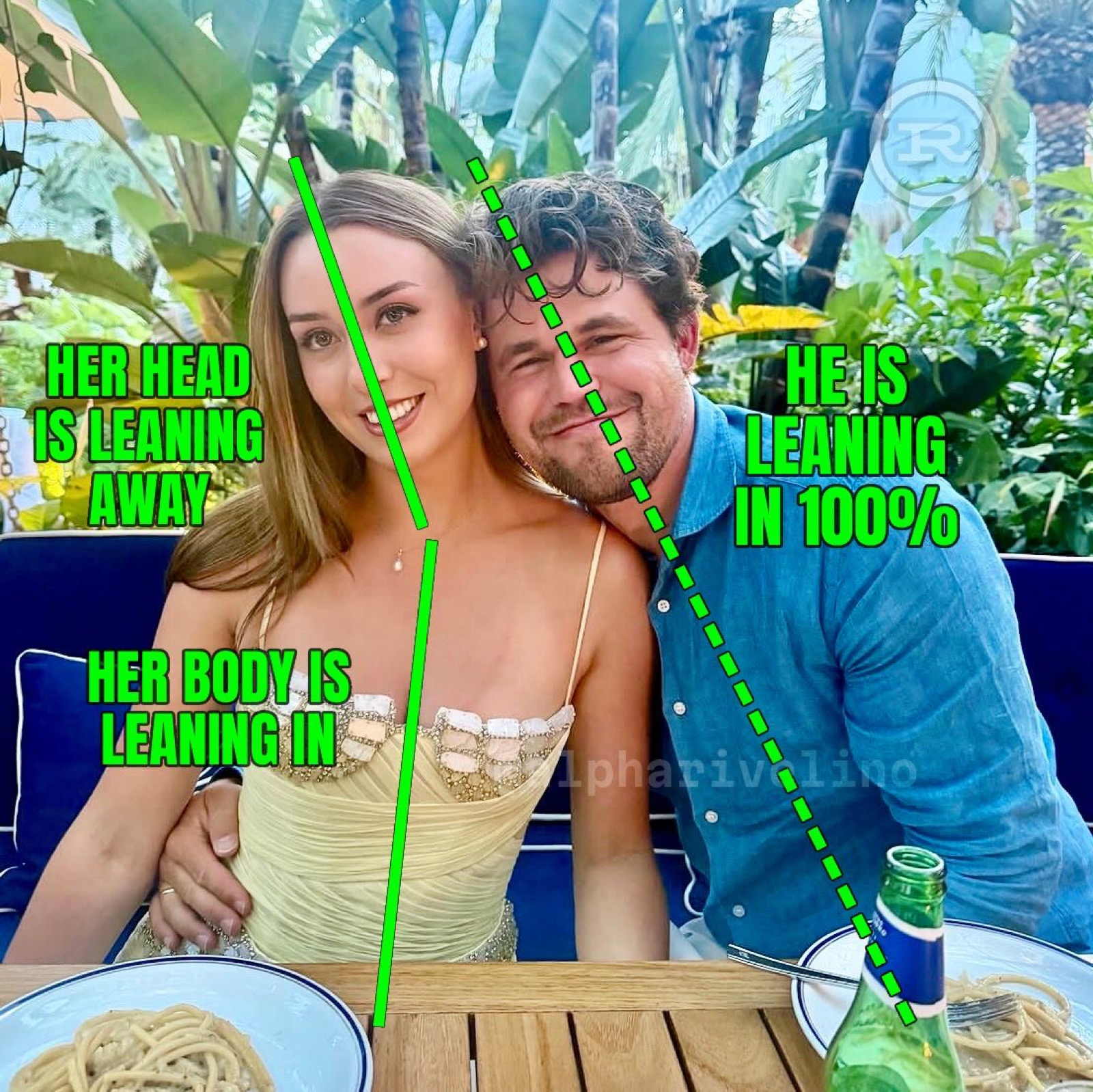
Green Line Test When Both People Lean In
You ran a couple photo through the Green Line Test expecting one clean "STRONG" result and one "WEAK" one. Instead, both green lines tilted toward each other. So what does a double lean actually mean?
Short answer: it is usually a good sign. When both people lean in, the classic strong-versus-weak framing falls apart, and what you are really looking at is mutual investment — two people drawn toward each other rather than one person doing all the work. Let's unpack it.
What a Double Lean Means in Green Line Theory
The original Green Line Theory assumes a power imbalance: one partner stands upright and "holds their frame," while the other leans in and supposedly gives up power. It is a tidy story, and it is also a big oversimplification.
When both lines lean toward the center, that imbalance disappears. Neither person is the lone leaner. Instead, the pose reads as:
- Mutual attraction — both bodies are oriented toward each other
- Shared closeness — neither partner is holding back or standing apart
- Symmetry — the pose is balanced, not one-sided
In body-language terms, this is closer to postural mirroring, where connected couples unconsciously match each other's angles and gestures. Far from a red flag, mirroring is one of the more reliable real-world signals that two people feel comfortable together. For the full breakdown of every outcome, see our guide to Green Line Test results.
Why Both People End Up Leaning
A double lean is extremely common, and most of the reasons have nothing to do with "weakness."
- Candid affection. In a genuine hug or a relaxed photo, people naturally curve toward each other. That is warmth, not weakness.
- A height difference. When one partner is much taller, both often adjust — one dips down, the other tips up — so their heads meet. See our full look at how height difference skews results.
- Camera angle and lens distortion. A tilted phone, a wide lens, or an off-center shot can make two upright people both appear to lean. The camera lies more often than people realize.
- Sitting or posing on furniture. On a couch, a bench, or a railing, both bodies tilt for comfort. Our sitting-photo guide covers why seated poses throw the test off.
- They were told to pose that way. Photographers constantly direct couples to "lean in together" for a flattering shot.
The takeaway: posture in a single frame is shaped by dozens of accidental factors. That is a big part of why the test is fun rather than diagnostic — a point we dig into in does the Green Line Test actually work?
How Our Tool Labels a Double Lean
Our AI does not force a fake "winner" when both people lean. Instead it reads each person's posture independently and reflects what it sees:
- If both lines tilt inward, the result leans toward a mutual / balanced read rather than a lopsided STRONG versus WEAK.
- The tool still draws a green line down each spine so you can compare the actual angles yourself.
- You get a shareable image either way — a double lean often makes the sweetest result to post.
Want to run your own pictures? Here is how to test your own photos for the cleanest reading.
What the Experts Actually Say
This is the important part. Body-language professionals broadly agree that leaning in signals interest and warmth, not weakness. Leaning toward someone is a long-recognized sign of engagement and attraction, and researchers on nonverbal communication describe it as an "immediacy" behavior — a way people show they like and want to be near someone. Several communication specialists have also publicly called the Green Line Test unreliable as a diagnostic tool, even while noting posture can add color in a broader context.
So a double lean, read honestly, points toward closeness. For more, see our roundup of what body-language experts say about couple photos.
A Quick Note on the "Weakness" Framing
The Green Line Theory picked up steam in corners of the internet that treated leaning as "losing" and standing rigid as "winning." That framing is both wrong and unhelpful — a relationship is not a contest to see who cares less. We cover why that mindset misses the point in is the Green Line Test toxic?
Two people leaning toward each other is not two people losing. It is two people who look comfortable being close. That is the whole point of a nice couple photo — and you can see it in plenty of the celebrity examples that made this trend go viral.
Try It on Your Own Photos
Curious what your favorite couple picture reveals? Upload it and see whether you get a single lean, a double lean, or two people standing tall:
- Upload any couple photo
- Our AI reads each person's posture
- Get your green lines and labels in seconds
- Download and share the result
Remember: it is for fun, not a verdict. A double lean usually just means you caught a genuinely close moment.